
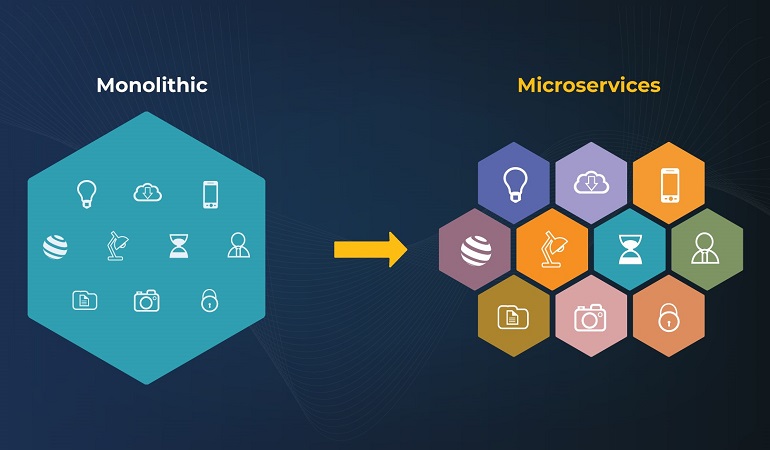
In recent years, the shift toward microservices architecture has gained significant importance in the software development industry. Microservices present several benefits compared to conventional monolithic applications, such as enhanced scalability, better isolation of faults, and quicker deployment cycles. Converting monolithic application to microservices can be a complex undertaking, but the benefits are well worth the effort.
In this article, we will explore how to convert monolithic to microservices, along with the key steps in the migration process and some examples.
What are Monolithic Applications?
A monolithic application is a software application that is built as a single, indivisible unit. All the application components, such as the user interface, business logic, and data access layers, are tightly coupled and run within a single process.
Monolithic applications are often characterized by their large codebases, complex dependencies, and limited scalability.
What is Microservices Architecture?
Microservices architecture is a way of building software by breaking an application into many small, independent parts called services. Each service does one specific job, runs on its own, and communicates with other services using simple methods like HTTP requests or message queues.
Because each service is separate, teams can build, update, deploy, and scale them independently without affecting the whole system. This makes the application more flexible, modular, and easier to change over time.
Why Convert a Monolithic Application to Microservices?
The reason why a company should switch their monolithic application to microservices is due to the immense benefits it offers, not to mention that monolithic apps are fast becoming outdated.
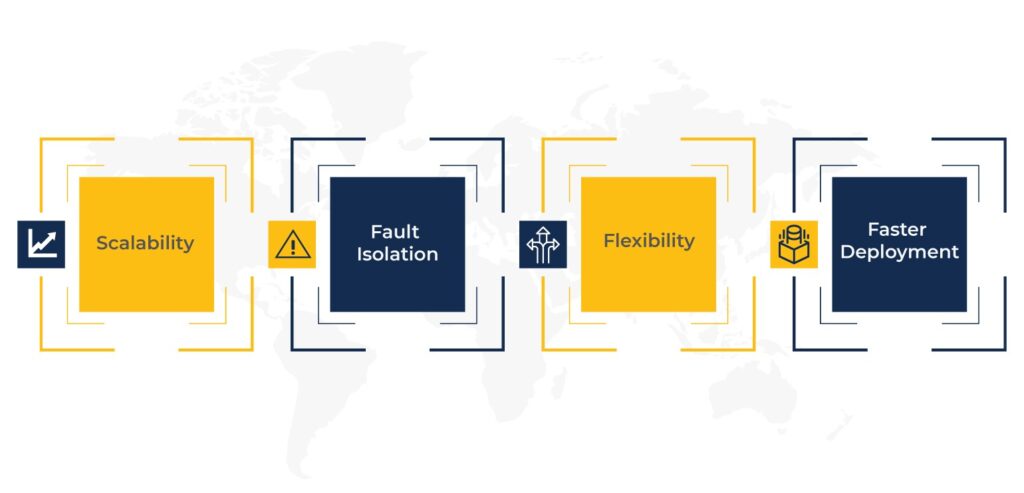
Here are some of the significant advantages of using a microservices-based architecture for your application.
1. Scalability
Microservices allow for horizontal scaling, meaning you can scale individual services independently based on demand. This enables better resource utilization and improved performance.
2. Fault Isolation
A major drawback of a monolithic application is that a problem in one of its components can bring down the entire app. But a microservices-based architecture isolates failures from specific services, ensuring that the rest of the system remains unaffected in case an application component is not functioning properly.
3. Flexibility
Microservices provide flexibility in technological choices. You can develop different services using various programming languages, frameworks, or databases based on specific requirements.
4. Faster Deployment
A microservices-based application enables faster deployment cycles since you can deploy each service independently. This allows for more frequent updates and feature releases.
Steps on how to convert monolithic to microservices architecture
Here is a step-by-step approach on how to convert monolithic to microservices architecture.
1. Identify the logical components
The first step is understanding what your system actually does. There are three core types of information you need to identify: data objects, data actions, and use cases. These components appear in the codebase as modules. Your task is to map them out and group similar ones together.
Identifying the logical components gives you a clear picture of what the system is made of and how it all fits together.
2. Refactor the components
Before you turn components into services, you need to remove duplicates and inconsistencies. When merging multiple systems or cleaning up old code, it’s common to find outdated logic or duplicate functions.
The goal in this step is to ensure that every piece of data and logic has one clear, correct version before being moved into a microservice.
3. Find component dependencies
Now you need to figure out how different parts of the system depend on each other. Static analysis and dynamic analysis are two different ways of identifying these dependencies.
This creates a visual map of how tightly connected parts of the system are. So architects understand which components are safe to separate and which ones are tightly intertwined.
4. Group dependant components
Using the dependency map, group components that belong together. Such logically compatible components create a small set of related data objects. These groups can eventually become microservices.
5. Create system user interface API
The API becomes the one gateway through which all user interfaces and applications communicate with the system. It will serve both the old monolithic parts and the new microservices during the migration.
6. Move components groups into macroservices
Macroservices are larger services that act as intermediate steps because monolithic systems are often too tangled to break apart cleanly. They are useful to create early separations and set the stage for microservices.
7. Decompose macroservices into microservices
Once macroservices are in place, you can gradually split them into true microservices. This step reveals deeper insights into how components interact and how to separate them effectively. When finished, your application becomes a collection of clean, independent microservices.
8. Deploy and test the services
You need to test each new service thoroughly before replacing monolithic components. Once everything points to the new microservice and no legacy dependencies remain, the service can be fully deployed into production.
This cycle repeats for each component group until the entire monolith has been replaced.
Real-world monolithic application to microservices examples
Here are some examples of companies that have converted their monolithic applications to microservices architectures.
- Netflix – Netflix used to have a monolithic application for its video streaming service. The application was difficult to scale and maintain, so Netflix converted it to a microservices architecture. This allowed Netflix to scale its video streaming service to meet the needs of its growing user base.
- Amazon – Amazon’s monolithic application for its e-commerce website made it very challenging to add new features. By converting it to a microservices architecture, Amazon was able to add new features to its application seamlessly.
- eBay – eBay struggled to maintain its monolithic application for its online marketplace. Therefore, the company decided to switch to a microservices architecture, allowing it to improve the performance and reliability of its online marketplace.
A Practical Convert Monolith to Microservices Case Study
Converting a monolithic application into a microservices based architecture involves several steps. Let us look at the high-level process:
1. Identify Business Capabilities
Analyze the monolithic application and identify distinct business capabilities or functionalities your development team can decouple into individual services. Each service should have a clear purpose and be responsible for a specific task.
2. Define Service Boundaries
Determine the boundaries between the identified services. This involves understanding the dependencies and interactions between different components of the monolithic application and defining how they can be split into separate services.
3. Refactor and Extract Services
Extract the identified services from the monolithic application, refactoring the code and separating the concerns. This step requires careful attention to ensure that each service is self-contained and has well-defined interfaces.
4. Establish Communication Mechanisms
Design and implement communication mechanisms between the services. You can achieve this through synchronous or asynchronous protocols, such as REST APIs, message queues, or event-driven architectures.
5. Data Management
Address the data layer by deciding how data will be managed across services. This may involve migrating to a microservices-friendly database or implementing data synchronization mechanisms.
6. Implement Service Orchestration
Define the overall flow and coordination of the services. This can be done using various approaches, including choreography or a centralized orchestration mechanism.
7. Implement Infrastructure and Deployment Automation
Set up the necessary infrastructure, such as containerization platforms or serverless environments, to support the deployment and management of microservices. Automate the deployment process to enable faster iterations and scaling.
Conclusion
Converting a monolithic application into a microservices based application architecture is a complex process that requires careful planning and implementation. Organizations can reap the benefits of scalable, high-performing apps by breaking down a monolithic application into smaller, loosely coupled services.
Although the conversion process involves challenges and considerations, the long-term advantages make it a worthwhile endeavor for modernizing and future-proofing software systems in today’s dynamic and rapidly evolving technology landscape.
If you need assistance in converting your monolithic enterprise application to a microservices-based architecture, feel free to contact us at [email protected]. Our team will reach out to you and book you a free consultation session to see how we can help you.