

Cloud computing has become the backbone of the enterprise technology landscape. Organizations rely on cloud platforms to run core applications, manage large-scale data, and support analytics and artificial intelligence workloads. As cloud adoption grows, many enterprises also turn to cloud cost optimization services to help manage spending and maintain financial control and to optimize cloud costs. The shift to cloud infrastructure has delivered speed, scalability, and operational flexibility, but it has also introduced a cost structure that behaves very differently from traditional IT spending.
According to the Flexera State of the Cloud Report, enterprise cloud spending increased by 28% year over year. What makes this growth challenging is not only the scale of the expenditure, but the fact that a significant portion of it does not translate into business value. Flexera also reports that approximately 32% of cloud spend is wasted due to idle resources, overprovisioned services, and limited cost governance.
Cloud cost optimization addresses this gap. It ensures that cloud spending remains aligned with real usage, operational priorities, and financial planning. This guide explains cloud cost optimization in depth, focusing on why enterprise cloud costs increase, how inefficiencies form, what optimization looks like in practice, and how enterprises are actively managing cloud costs today.
What is cloud cost optimization?
Cloud cost optimization means managing cloud resources regularly so organizations use only what they need and pay only for what they use. It does not mean cutting costs once or checking bills at the end of the month. Instead, it focuses on managing cloud usage as part of everyday operations — an approach often supported through cloud managed services that provide ongoing oversight, automation, and governance.
In enterprise environments, optimize cloud costs serves three core purposes:
- Stopping unnecessary resource usage before it starts
- Making cloud spending easy to see and understand across teams
- Helping organizations plan budgets and manage spending with confidence
Cloud platforms are dynamic by design. Resources can be provisioned instantly, scaled automatically, and billed based on consumption. Because environments change constantly, cost optimization must operate as an ongoing discipline embedded into daily operations rather than an occasional financial exercise.
Benefits of cloud cost optimization
Cloud cost optimization helps organizations manage cloud spending deliberately and in a controlled way. It ensures that cloud resources support real business needs while avoiding unnecessary costs.
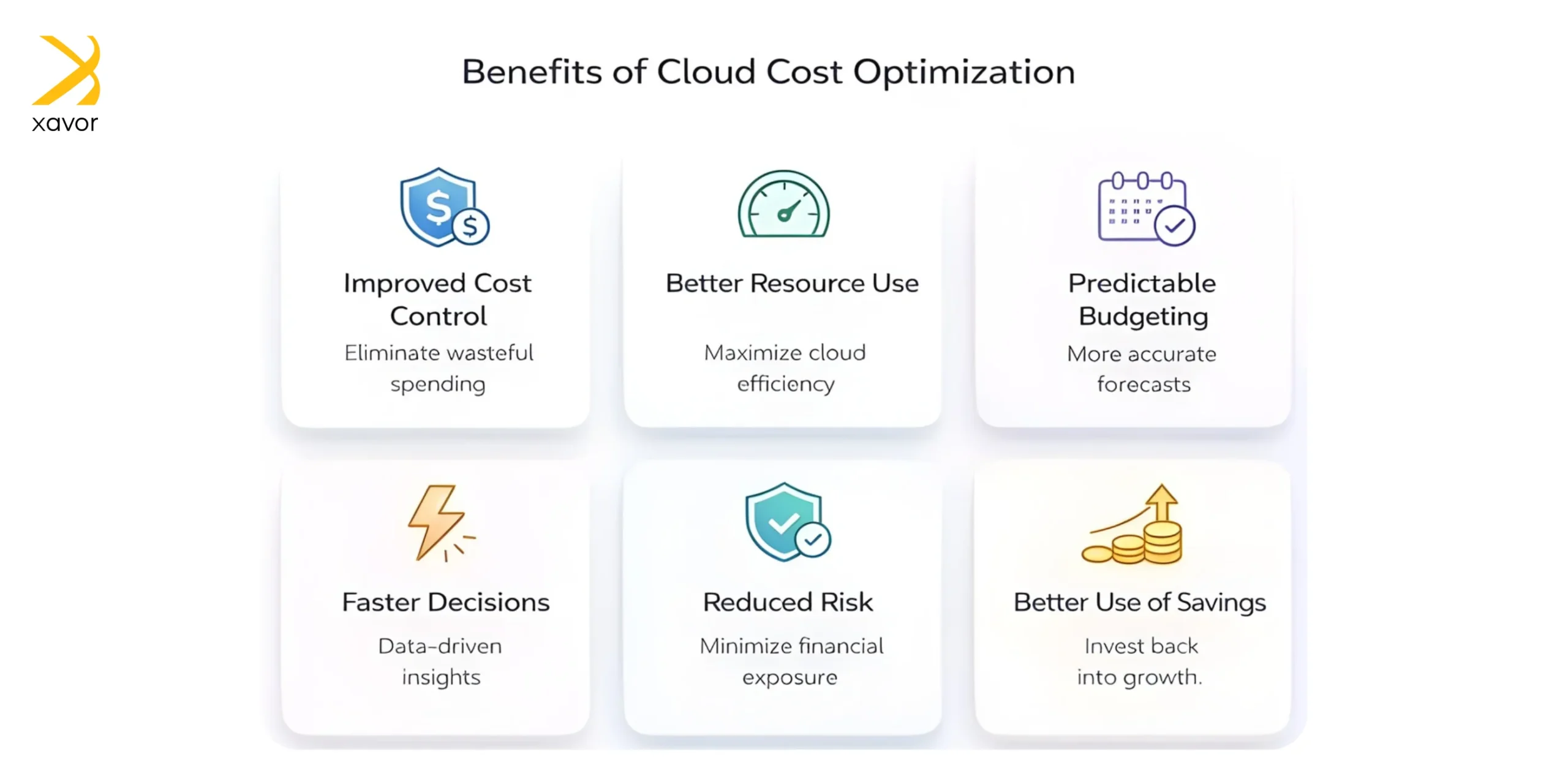
1. Improved cost control
Optimize cloud costs gives organizations clear visibility to where cloud spending goes. Teams can identify inefficiencies early and take action before costs grow. This reduces unexpected charges and supports financial stability.
2. Better use of cloud resources
Teams use cloud resources more efficiently by sizing infrastructure correctly and shutting down unused services. This approach ensures that resources deliver value relative to the cost they generate.
3. Predictable budgeting
When teams actively manage cloud usage, spending becomes more consistent. This helps organizations plan budgets with greater confidence and reduces the risk of sudden cost spikes.
4. Faster and informed decisions
Optimizing cloud costs helps teams understand the cost impact of their actions during development and operations. With better awareness, teams make responsible decisions without slowing delivery or adding unnecessary approval steps.
5. Reduced operational risk
Early identification of unusual spending patterns enables teams to correct configuration issues quickly. This reduces the risk of budget overruns and unexpected operational disruptions.
6. Better use of savings
By eliminating waste, organizations free up budget to redirect toward higher-priority initiatives. These savings support system improvements, innovation, and long-term growth.
Cloud cost optimization best practices
Core cloud cost optimization practices focus on controlling the most persistent and high-impact cost drivers in enterprise cloud environments. These practices determine how infrastructure is provisioned, how long it remains active, and how efficiently pricing models are applied. When implemented consistently, they reduce waste while maintaining performance, reliability, and operational continuity.
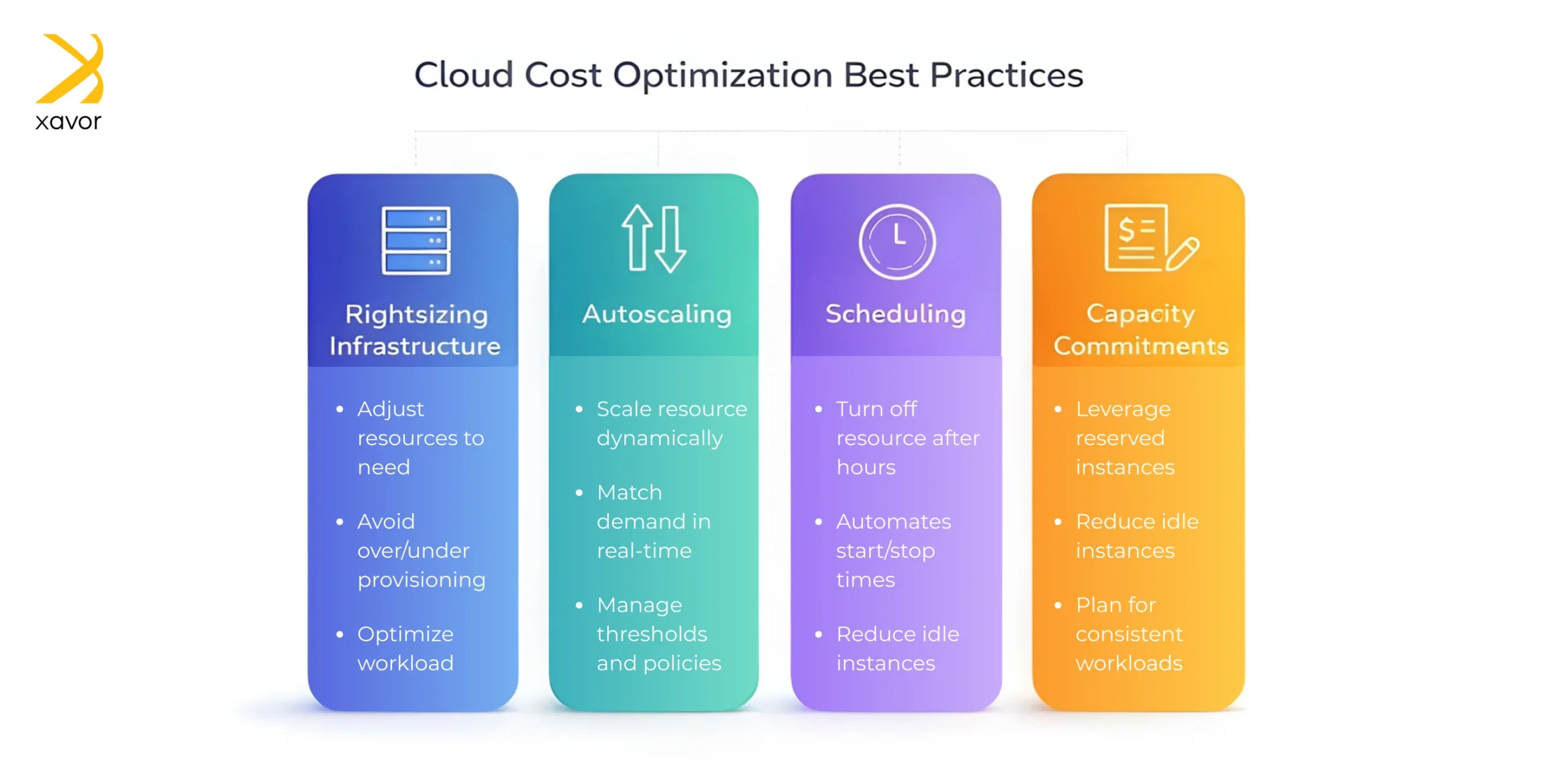
1. Rightsizing Infrastructure
Rightsizing ensures that cloud resources are provisioned based on actual workload usage rather than conservative peak assumptions. In many enterprise environments, enterprise cloud services are essential for maintaining performance and avoiding over-allocation. Infrastructure is often initially sized larger than necessary to avoid performance risk and is rarely adjusted afterward, leading to persistent over-allocation.
By continuously evaluating utilization of metrics such as compute, memory, and storage consumption, enterprises can adjust resource configurations to match actual demand better. This reduces recurring costs while maintaining required performance levels and prevents inefficiencies from becoming permanent as workloads evolve.
2. Autoscaling
Autoscaling dynamically adjusts infrastructure capacity in response to workload demand. Rather than maintaining a fixed capacity at all times, resources scale up during high-usage periods and scale down when demand decreases.
This approach eliminates the need to pay for unused capacity during low-usage periods while still supporting performance during traffic spikes. Autoscaling is especially effective for workloads with variable or unpredictable demand patterns, where static provisioning results in unnecessary costs.
3. Scheduling non-production environments
Non-production environments such as development, testing, and staging often run continuously even though they are used only during limited time windows. Keeping these environments running around the clock generates cost without corresponding business value.
Scheduling addresses this inefficiency by automatically stopping non-production resources during idle periods and restarting them when needed. When implemented consistently, scheduling reduces unnecessary spending while preserving developer productivity and delivery timelines.
4. Capacity commitments
Capacity commitments reduce cloud costs by offering lower pricing in exchange for a commitment to use a specific level of resources over time. These commitments are appropriate for workloads with stable, predictable usage that run continuously.
To be effective, commitments must be based on validated usage patterns and reviewed regularly. When combined with rightsizing and autoscaling, they reduce costs for baseline workloads while preserving flexibility for workloads with changing demand.
Why enterprise cloud costs increase over time
Enterprise cloud costs increase over time because cloud environments naturally accumulate resources, services, and usage unless they are actively governed. Even when business demand appears stable, spending often rises due to how cloud platforms are structured and how teams interact with them.
This increase happens through several predictable mechanisms:
1. Resources are easy to create but rarely removed
Cloud platforms are designed to make provisioning simple. Virtual machines, databases, storage volumes, and services can be created in minutes. Removing them requires deliberate action.
Over time, enterprises accumulate:
- Temporary environments created for testing or short-term initiatives
- Storage volumes detached from applications
- Backups and snapshots are retained far beyond their useful life
Enterprises without automated cleanup and lifecycle policies experience steady month-over-month growth in cloud costs even when application usage remains flat. Because unused resources continue to exist until explicitly removed, costs grow incrementally with every deployment cycle.
2. Architectures expand incrementally
As enterprises mature their cloud usage, architectures grow broader even if core applications do not change.
Additional services are introduced to support:
- Monitoring and observability
- Security controls and compliance requirements
- Data replication and resilience
- Data analytics and reporting
Large enterprises add 15%–20% new cloud services each year. These services add value, but they also introduce recurring costs that accumulate over time.
3. Usage-based pricing amplifies gradual growth
Cloud pricing is based on consumption rather than fixed capacity. Costs increase as data volumes grow, network traffic expands, and background processes run continuously.
Data transfer and inter-service communication costs tend to rise steadily as systems become more interconnected. These increases are often small individually but significant when accumulated over months and years.
4. Human decision patterns compound cost
Enterprise cloud environments involve many teams making independent decisions. Teams often allocate extra capacity to avoid performance risk. There is usually little immediate pressure to remove unused resources.
Organizations without shared cost accountability experience compounding inefficiencies that lead to year-over-year cloud cost growth.
Business impact of uncontrolled cloud spending
1. Financial unpredictability
When cloud costs change unpredictably, budgeting becomes reactive. Finance teams struggle to forecast monthly spending accurately, and technology teams lack clear financial boundaries for planning.
According to the Flexera State of the Cloud Report, 94% of enterprises report difficulty predicting cloud costs with confidence.
2. Reduced capacity for strategic investment
Money spent on unused or inefficient cloud resources is not available for high-impact initiatives such as product development, advanced analytics, security improvements, and customer experience enhancements.
According to Boston Consulting Group, enterprises that actively optimize cloud costs, redirect 15%–20% of cloud budgets toward higher-value initiatives over time.
3. Governance and compliance risk
Limited visibility into cloud usage complicates audit preparation and compliance efforts. Without clear ownership and traceability, enterprises face higher remediation efforts during regulatory reviews.
The PwC Cloud Risk Study highlights that weak cloud governance significantly increases operational disruption during audits.
Managing cloud costs through FinOps
What FinOps provides
FinOps is a financial management discipline designed specifically for cloud environments. It aligns cloud usage decisions with financial accountability by bringing structure and transparency to cloud spending.
According to the FinOps Foundation, organizations adopting FinOps practices typically reduce cloud waste by 20%–35% within 12–18 months.
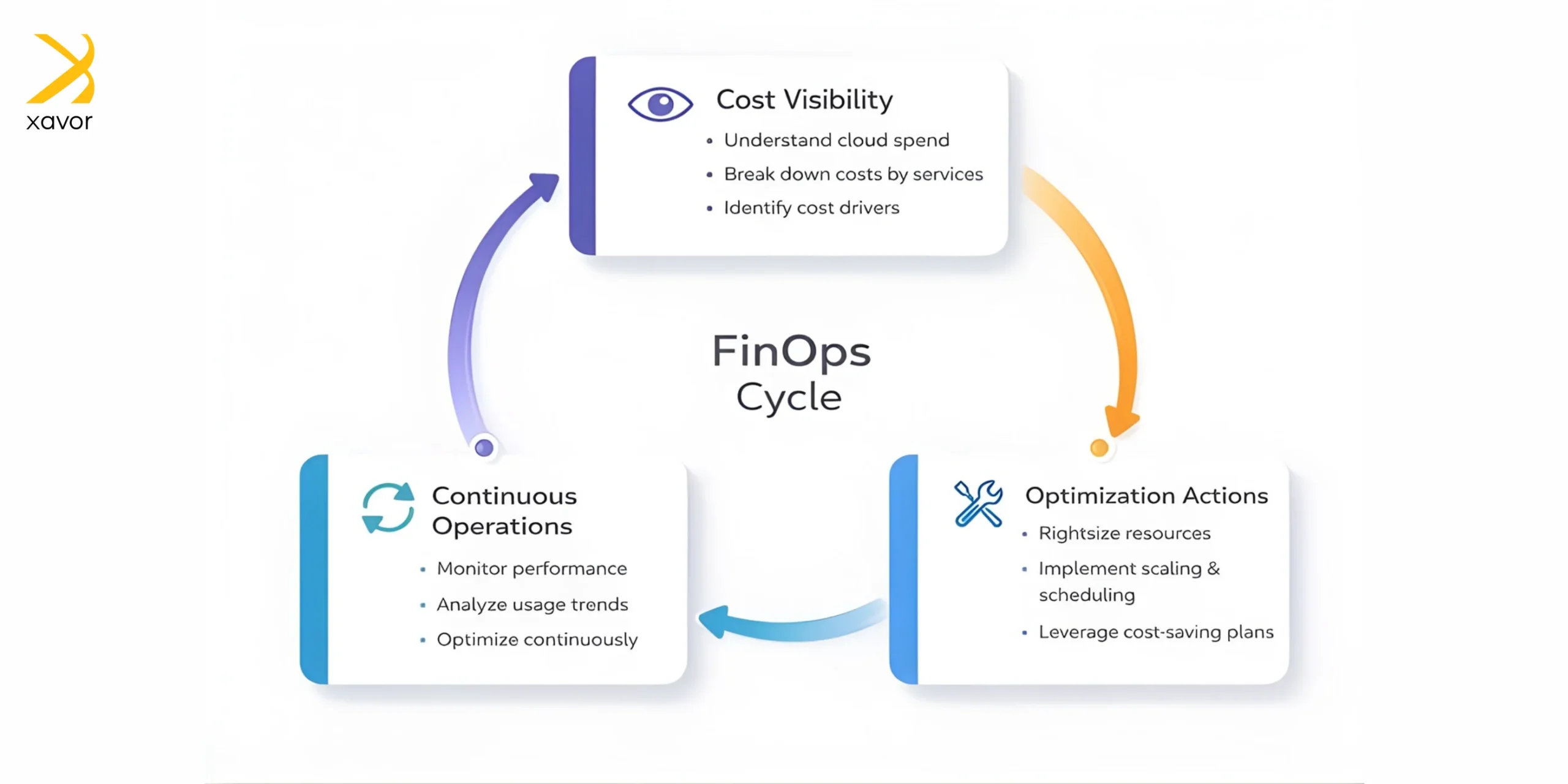
How FinOps works in practice
1. Cost visibility
The first step is visibility. Enterprises centralize billing data and apply consistent tagging so that costs can be attributed to workloads, teams, and environments.
2. Optimization actions
Once costs are visible, enterprises focus on targeted actions such as rightsizing, scheduling non-production environments, and planning capacity commitments.
3. Continuous operations
Optimization is sustained through policy enforcement, ongoing monitoring, and regular cost reviews. This prevents inefficiencies from reappearing after initial improvements.
Cost management in multi-cloud and hybrid environments
As enterprises grow, many move beyond a single cloud provider. Multi-cloud and hybrid cloud strategies are often adopted to address regulatory requirements, geographic availability, vendor dependency, or post-merger integration. While these approaches offer operational flexibility, they significantly increase the complexity of cost management.
Each cloud provider uses different pricing models, billing dimensions, discount structures, and terminology. Compute, storage, network, and managed services are priced differently across platforms. Without a unified view, enterprises struggle to understand total spending, identify inefficiencies, or compare cost-effectiveness across providers.
In multi-cloud environments, common cost challenges include:
- Fragmented billing data across providers
- Inconsistent tagging and cost allocation standards
- Duplicate services running on different platforms
- Difficulty identifying which workloads are driving cost growth
According to Forrester, enterprises that manage cloud providers independently often experience uncontrolled cost growth due to a lack of consolidated visibility. In contrast, organizations that centralize multi-cloud cost management reduce overall cloud spend by 25%–40% by eliminating duplication and improving accountability.
Hybrid environments add another layer of complexity. Data frequently moves between on-premises systems and cloud platforms for synchronization, analytics, and backup purposes. These data transfers introduce recurring network and egress costs that grow as data volumes increase.
Effective cost management in multi-cloud and hybrid environments requires:
- Centralized cost visibility across all platforms
- Consistent tagging and allocation policies
- Ongoing monitoring of data movement patterns
- Intentional workload placement based on cost and performance
Without these controls, hybrid and multi-cloud architectures gradually become major cost multipliers rather than strategic enablers.
To better understand how hybrid cloud models operate in enterprise environments, see What is Enterprise Hybrid Cloud: An Ultimate Guide.
Technologies supporting cloud cost optimization
Enterprise cloud environments are highly complex, making manual cost control impractical in most cases. Workloads change over time, teams introduce new services regularly, and usage patterns shift as business needs change. To manage costs effectively in this environment, organizations rely on technology-based solutions that help maintain financial control without disrupting daily work.
Modern cloud optimization uses cloud analytics, automation, and policy tools to guide how teams use cloud resources. These technologies do not replace governance frameworks such as FinOps. Instead, they help put governance into action by making cost awareness part of everyday cloud operations and routine decision-making.
Predictive cost analytics
Predictive cost analytics tools analyze historical usage data to forecast future cloud spending trends. Rather than reacting to cost overruns after invoices are generated, enterprises use forecasting to anticipate growth, identify risk areas, and plan capacity proactively.
This technology evaluates variables such as:
- Historical consumption patterns
- Seasonal workload fluctuations
- Application growth trends
- Infrastructure configuration changes
Forecasting supports informed planning for events such as product launches, traffic spikes, regional expansion, and new service adoption. It also improves communication between technical and financial teams by grounding discussions in forward-looking data rather than retrospective reports.
When forecasting is paired with alerts and thresholds, enterprises gain early warning signals that allow corrective action before costs become material.
Kubernetes cost visibility and optimization
Containerized environments introduce unique cost management challenges. Kubernetes clusters run multiple workloads on shared infrastructure, making it difficult to understand the actual cost of individual services, applications, or teams.
Without specialized tooling, container costs appear aggregated at the cluster level, obscuring accountability and limiting optimization opportunities.
Kubernetes cost management platforms address this by:
- Allocating infrastructure costs to namespaces, services, or workloads
- Identifying underutilized nodes and pods
- Recommending workload placement changes to reduce waste
- Supporting the use of lower-cost capacity where appropriate
Service-level cost visibility is essential for enterprises operating microservices architectures, where hundreds of services may share the same cluster. Accurate cost attribution enables informed decisions around optimization, pricing models, and architectural changes without compromising reliability.
Policy-based cost automation
Policy-based automation enforces cost controls automatically across cloud environments. Instead of relying on manual reviews or post-deployment audits, policies prevent inefficient configurations from being deployed in the first place.
Typical cost-related policies include:
- Limiting instance sizes by environment
- Enforcing mandatory tagging for cost allocation
- Restricting deployment to approved regions
- Preventing the creation of long-running non-production resources
Automation helps keep cost controls consistent. As cloud environments change and more teams use them, policies help manage costs without slowing daily work. This approach focuses on preventing cost issues early instead of fixing them later, which helps maintain long-term cost control.
How enterprises are actively managing cloud costs today
Enterprises are increasingly moving away from reactive cost correction toward proactive cost control. Rather than identifying waste after invoices arrive, organizations are embedding cost awareness directly into development, deployment, and operational processes.
- One major initiative is integrating cost guardrails into CI/CD pipelines. Infrastructure templates now include predefined cost thresholds and configuration standards, often supported by CI/CD automation that helps teams enforce consistency and efficiency across build, test, and deployment workflows. Deployments that exceed these thresholds are flagged or blocked before reaching production, ensuring that inefficient infrastructure never becomes operational.
- Another active practice is providing real-time cost feedback during infrastructure provisioning. Engineers can see the estimated cost impact while designing or deploying resources. This encourages cost-aware decision-making without introducing approval delays or slowing delivery cycles.
- Automated cost anomaly detection has also become common. These systems continuously monitor usage and flag abnormal spending patterns, such as runaway workloads, misconfigured autoscaling rules, or unexpected data transfer activity. Early detection reduces both financial exposure and operational risk.
- In containerized environments, enterprises are implementing service-level cost attribution to distribute shared infrastructure costs accurately across microservices. This improves accountability and supports application-level optimization.
- AI and machine learning workloads are receiving increased attention due to their cost intensity. Enterprises are actively optimizing these workloads through scheduling, separation of training and inference environments, and selective use of lower-cost compute options.
Measuring cloud cost optimization success
Measuring cloud cost optimization success requires a focus on outcomes rather than activities. The goal is not to track how many actions were taken, but whether cloud spending becomes more predictable, accountable, and efficient over time.
Key metrics to track
To assess the effectiveness of cloud cost optimization efforts, enterprises should monitor a defined set of metrics. These indicators help link cost management actions with financial and operational outcomes.
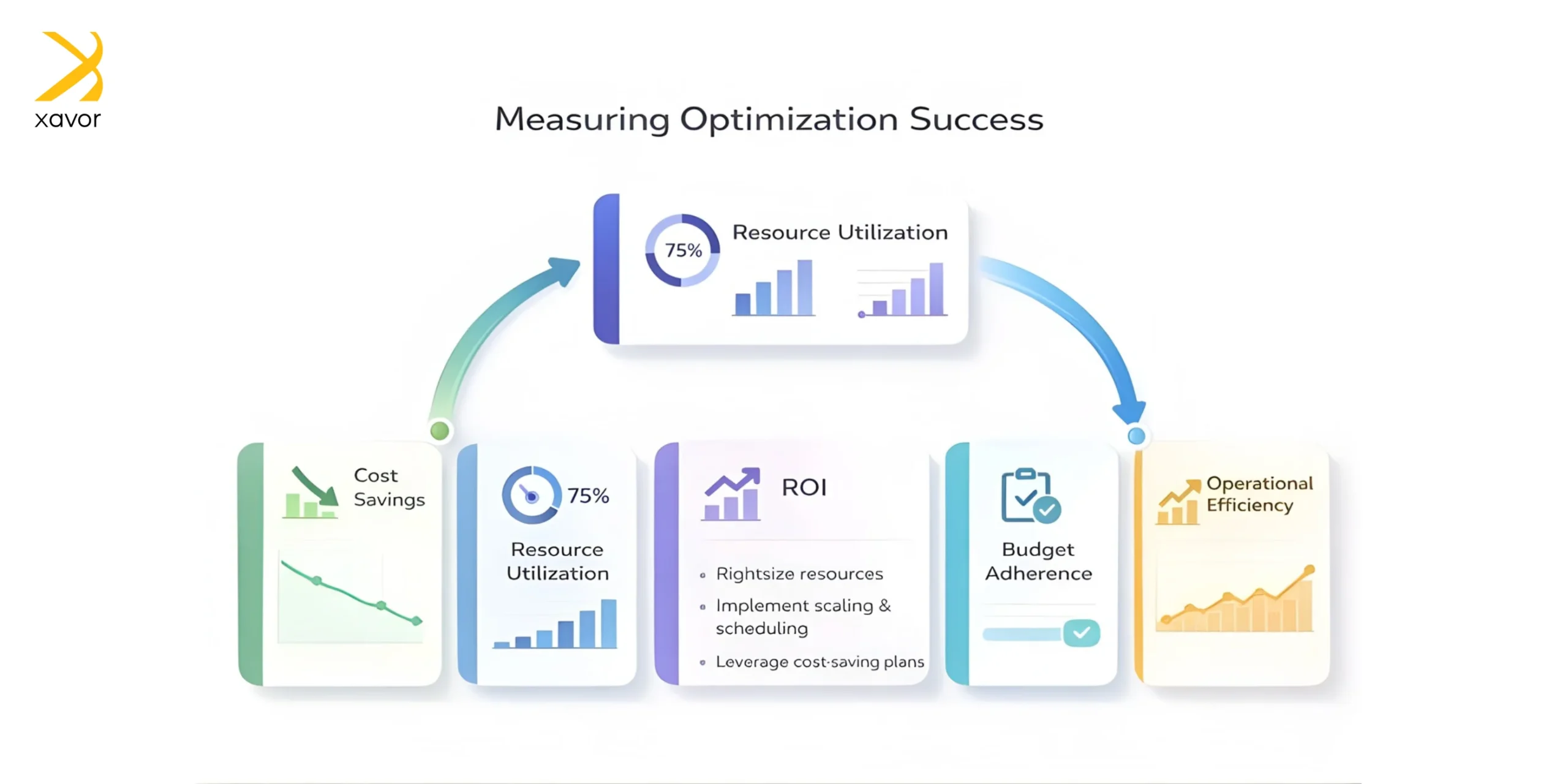
- Cost savings: Track the reduction in cloud spending over time to understand the direct financial impact of optimization initiatives.
- Resource utilization: Measure the proportion of cloud resources actively used compared to those provisioned to identify over-allocation and inefficiencies.
- Return on Investment (ROI): Calculate the return generated from optimization efforts by comparing cost savings against investment in tools, processes, and effort.
- Budget adherence: Evaluate how closely actual cloud spending aligns with predefined budgets and forecasts.
- Operational efficiency: Monitor improvements in workload management, deployment processes, and overall resource handling as a result of optimization.
Case studies and success examples
- Retail enterprise: A global retailer lowered cloud costs by 30% by applying rightsizing and reserved capacity strategies. The organization redirected the savings into improving customer experience initiatives.
- Healthcare provider: A healthcare organization achieved 40% cloud cost savings by implementing autoscaling and governance policies while continuing to meet compliance and operational requirements.
- Technology startup: A startup reduced cloud expenses by 50% through flexible computing options and automation tools, enabling faster product development without increasing infrastructure spend. They utilised various edge and cloud computing strategies to optimize workloads and manage costs effectively.
Tips: Do’s and don’ts of cloud cost optimization
| Do’s | Don’ts |
| Review cloud usage and spending regularly to spot inefficiencies early. | Ignore indirect costs such as data transfer, storage growth, and service-to-service communication. |
| Use automation to manage scaling, scheduling, and cost controls. | Rely only on manual reviews to manage cloud spending. |
| Train teams to understand how their decisions affect cloud costs. | Overlook training and cost awareness across teams. |
| Work with cloud providers to secure pricing aligned with real usage. | Accept default pricing models without evaluation or negotiation. |
| Revisit optimization practices regularly as workloads change. | Assume early optimization decisions will remain effective over time. |
Conclusion
Cloud cost optimization ultimately comes down to intent and discipline. The cloud gives enterprises flexibility and speed, but without deliberate oversight, that flexibility quietly turns into financial drift. The organizations that manage cloud costs well do not rely on tools alone. They create habits, processes, and shared responsibility around how cloud resources get used every day.
Effective cloud cost optimization does not slow teams down or limit innovation. It creates clarity. Teams understand the cost impact of their decisions, finance gains confidence in forecasts, and leadership can invest with purpose instead of reacting to surprises. Over time, this clarity strengthens trust between technical and business teams and supports better decisions across the organization. Enterprises that approach cloud cost optimization as an ongoing practice build environments that remain efficient even as technology, workloads, and priorities change. They stay in control not because they spend less, but because they spend intentionally.
If your organization is looking to bring structure, visibility, and consistency to cloud cost management, Xavor can help. Our teams work closely with enterprises to design practical cloud cost optimization strategies, implement the right controls, and embed cost awareness into everyday operations.
To start the conversation or learn more about how Xavor supports enterprise cloud cost optimization, reach out at [email protected].

FAQs
Cloud cost optimization is the ongoing process of managing cloud resources to reduce unnecessary spend, use infrastructure efficiently, and ensure cloud costs align with actual business and workload needs.
Cloud cost optimization helps enterprises keep spending under control, optimize resource use, and free up budget for higher-priority initiatives. It supports financial stability while allowing teams to continue operating at a scale.
Enterprises can start by reviewing current cloud usage, identifying unused or oversized resources, and applying basic optimization practices such as rightsizing, autoscaling, and environment scheduling.