
OpenAI has made a significant stride forward with the launch of GPT-5, which is claimed to be its most capable large language model (LLM). Users, experts, and tech enthusiasts were wondering since last year when will GPT 5 be released.
Fortunately, they didn’t had to wait long as OpenAI officially released GPT-5 across platforms this August. Chat GPT 5 is faster and more advanced than its predecessors. The AI company has said that it’s fundamentally redesigned, which allows it to know when to think harder for more complex queries.
The release of GPT-5 shows OpenAI’s commitment to advancing AI and machine learning solutions at an unprecedented pace. But what should we expect from Chat GPT 5?
This article will explain everything you need to know about GPT-5. It will explore ChatGPT 5 features, how it compares to earlier models, and what it means for the future of technology in the coming decade.
What is ChatGPT 5?
GPT-5 is a generative pre-trained transformer model that follows GPT-4 and its related versions, including GPT-4o. It is a multimodal large language model capable of processing and analyzing text, images, and audio. Its advanced abilities come from extensive training on a wide range of datasets. The decksyai.com slideshow maker uses this advanced GPT to instantly transform raw concepts into structured slides and visuals. While AI presentation makers create visuals with unique models and processing, GPT-5 uses a unified architecture, which is a single, all-in-one system that decides the best way to handle each request.
Unlike earlier versions, GPT-5 includes built-in reasoning capabilities, allowing it to spend more time interpreting, assessing, and responding to user prompts more effectively.
ChatGPT 5 release date
Followers of OpenAI were anticipating the GPT-5 release date for quite some time. After all, the last updated model, GPT-4, was released two years ago. Finally, on August 6, 2025, OpenAI posted a teaser on X that hinted at the release of Chat GPT 5.
The very next day, on August 7, OpenAI made ChatGPT 5 available to users across the globe.
The big deal: ChatGPT 5’s new features
How advanced will ChatGPT 5 be? This question is on many users’ minds. Sam Altman, the CEO of OpenAI, answered this in his address that GPT-5 was “generally intelligent” and a significant progress in artificial general intelligence (AGI).
From a surface look, while GPT-5 significantly reduces hallucinations, businesses still need ways to verify AI-generated content. Tools like AI detectors and humanizers can help ensure authenticity and compliance, especially in sensitive industries. These better ChatGPT 5 features are major improvements over previous models. These advancements also reflect the growing distinction between AI models designed for creative content generation, such as compiling visual layouts and content for flipbooks, and those built for more autonomous, goal-oriented tasks.
But let’s take a deeper look at OpenAI GPT-5.
Unified architecture
GPT-5 uses a unified architecture, which is a single, all-in-one system that decides the best way to handle each request. This is a step away from the previous models like GPT-4o that used multiple specialized models for different tasks.
So instead of jumping between separate tools or models behind the scenes, GPT-5 can fluidly switch and combine abilities within one system. Intelligently routing user requests this way makes it more coherent and easier to use.
The model is able to do that based on its three core components that work in tandem:
- GPT-5-main: The core LLM model, which is the successor to GPT-4o, but with the capacity to handle more queries.
- GPT-5-thinking: A more powerful model for deeper thinking involving complex tasks.
- Real-time router: The router decides which model to use depending on the complexity, context, and intent of the user request.
Safety completions
When users asked tricky or sensitive questions to earlier models, ChatGPT would say I can’t help you on this or would give a very vague answer, often hallucinating and making things up. ChatGPT 5 doesn’t do that; instead, it tries to give a carefully limited, relevant answer that stays within safe boundaries.
This makes GPT-5 a better and more honest generative AI that can handle complex queries without making things up.
Coding assistance
Chat GPT 5 is a coding expert that can solve complex real-world coding challenges with a high rate of accuracy. It includes a set of big upgrades for developers, such as:
- API development: Developers can set a parameter in API development through reasoning_effort, which allows them to choose between faster answers or deeper analysis with more analytical depth.
- Custom tools: ChatGPT 5 lets you define tools in plain text with regular expressions to create complex, multi-step agents.
Context handling
Chat GPT 5 is designed to handle massive amounts of context. It can take 272,000 input tokens and give out 128,000 output tokens. That is the equivalent of analyzing a full-length novel and producing an extremely long summary of it.
GPT 4 vs 5
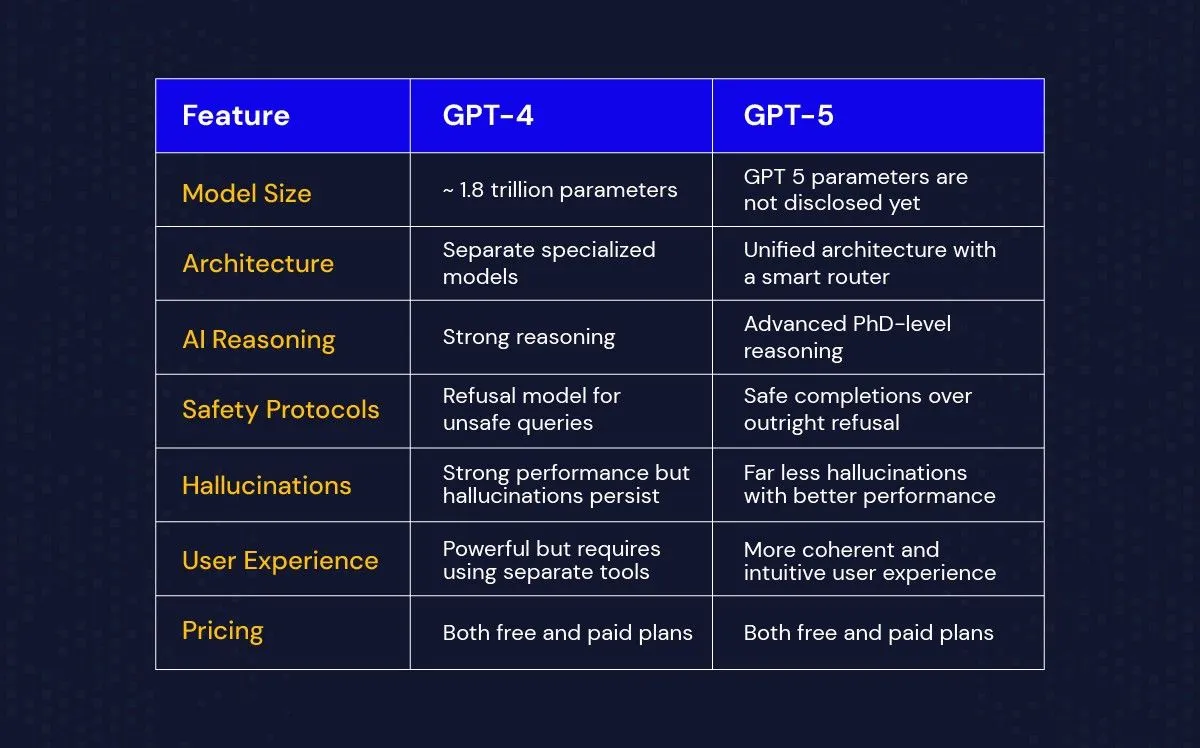
Chat GPT 5 has introduced major improvements over GPT-4 and its types like 4.5 and 4o. For example, GPT-5 is found to be 45% less likely to hallucinate and have factual errors in its answers.
Here is a brief GPT 4 vs GPT 5 comparison across different factors:
What are the different models of ChatGPT 5?
Like GPT-4, GPT-5 also comes with a series of models. Each is a specialized version for different use cases.
- GPT-5: The main model that is designed for logic and task handling, it offers upgraded AI reasoning and thought execution capabilities.
- GPT-5-mimi: A faster, lightweight, and cost-efficient version of GPT-5. Ideal in situations where you want speed and efficiency at a lower cost.
- GPT-5-nano: Fastest and cheapest version of GPT-5 with ultra-low latency. Perfect for instant response tasks like summarization.
- GPT-5-chat: The chat optimized version of GPT-5 that most people use. It is tuned for conversational flow and built on top of GPT-5’s architecture.
Impact of Chat GPT 5 in the tech world
ChatGPT 5 is still in its beta mode and will become better with time. However, it has already set a precedent for the future development of AI. For teams using it to draft content at scale, knowing how to humanize AI outputusing an AI humanizer like Stealth Writer, has become a practical step before anything goes live has become a practical step before anything goes live. Many creators also use a rephraser to improve sentence flow and readability while preserving the original meaning of AI-generated content. The era of generalist LLMs for every single task is over. It was inefficient and economically unsustainable.
2030 tech trends demand more modular approaches to AI development. GPT-5 capabilities are based on its Lego-like approach, which makes it cheaper to run, more intelligent at reasoning, and more accurate. It has started a new age of smaller, specialized AIs working together. As AI continues to influence education, students are exploring new ways to improve academic writing. Alongside AI tools, some learners consider whether to buy an essay when they need help with structure, research organisation, editing, and argument development. Used responsibly, such support can make complex assignments easier to understand and plan.
This unified approach will transform the future of AI applications and particularly their enterprise AI use cases in the real world. For example, GPT-5 can be a catalyst in HealthTech for better and more accurate diagnosis assistance.
Benefits for Businesses
Upgrading to GPT 5 gives businesses access to a more capable model than OpenAI’s earlier GPT 4 series. Its improvements, particularly the built-in reasoning router, enable organizations to manage more sophisticated workflows, such as automating complex operations in industries like finance and healthcare.
ChatGPT 5 also delivers faster performance and fewer hallucinations, which can give organizations greater confidence when using the model for business-critical tasks that directly impact customer experience.
Benefits for Developers
GPT-5 provides developers with stronger coding support, including more intelligent code generation, a larger context window for handling bigger projects, and API integrations that support the creation of AI agents. By adopting GPT-5, developers can speed up development cycles, reduce mistakes, and create more dynamic application experiences.
How to access ChatGPT 5
Chatting with GPT-5 is straightforward. Just log in to ChatGPT, and it automatically sets the right GPT-5 model depending on your plan without requiring any setup.
However, if you need GPT-5 in your development workflow or other product, you’ll need API access through:
- OpenAI’s developer platform, where you can select your GPT-5 model for different use cases.
- Installing OpenAI’s official Python library from GitHub for using GPT-5 in your own code. It lets you use GPT-5 models by calling Python functions in your script.
But do remember that accessing Chat GPT 5 through API access is paid, not free.
ChatGPT5 pricing
The pricing of Chat GPT 5 models is based on the number of tokens used. The unit price for input tokens and output tokens is different for each model.
Here is a table showing the pricing for each GPT-5 model per token:
| Model Type | Input Tokens | Output Tokens | Cutoff Date |
| GPT-5 | $1.25 | $10.00 | Oct 1, 2024 |
| GPT-mini | $0.25 | $2.00 | May 31, 2024 |
| GPT-nano | $0.05 | $0.40 | May 31, 2024 |
For smaller businesses and growing teams, model costs are usually only one part of the investment, as deployment, integrations, and ongoing optimization can increase total implementation expenses over time. As a result, organizations sometimes review different approaches to supporting temporary investment periods without delaying adoption initiatives.
Latest Update: GPT-5.4 expands OpenAI’s enterprise AI vision
Since the launch of GPT-5, OpenAI has continued to expand the model family with more enterprise-focused upgrades. In March 2026, the company introduced GPT-5.4, which described as its most capable and efficient model for professional work. According to reports, GPT-5.4 combines stronger reasoning, better coding performance, and more advanced agentic abilities, making it suitable for complex business workflows.
One of the biggest shifts with GPT-5.4 is its focus on agentic AI. Unlike earlier chat-focused systems, the new model can autonomously operate computers and software, search for and use external tools, and complete multi-step workflows with less manual setup from developers. OpenAI also positioned the model as more factual and reliable, with lower hallucination rates than GPT-5.2.
The launch also highlights OpenAI’s push into the enterprise productivity market. Alongside GPT-5.4, the company rolled out ChatGPT for Excel and Google Sheets in beta, as well as integrations with platforms such as FactSet, MSCI, Third Bridge, and Moody’s. These additions show that OpenAI is moving beyond general chatbot functionality toward tools that can support real financial, analytical, and operational work inside organizations.
GPT-5.4 is also available in multiple formats, including GPT-5.4 Thinking in ChatGPT and GPT-5.4 Pro for users who need stronger performance on complex tasks. In the API and Codex, OpenAI says the model supports up to 1 million tokens of context, which makes it much better suited for long, tool-dependent workflows and large knowledge tasks.
GPT-5 already showed the direction AI was moving in. GPT-5.4 makes that direction even clearer. The future of AI includes smarter systems that can think more carefully, use tools, work across software, and handle business tasks with less human support. GPT-5.4 does not replace GPT-5. It builds on the same vision and pushes it further.
What everyday users can expect from ChatGPT-5.4
For regular ChatGPT users, the biggest noticeable update is that GPT-5.4 Thinking now presents an upfront plan before beginning complex tasks. This allows users to step in, redirect, or refine the response as it unfolds without needing to restart from scratch, a change that can save considerable time on multi-step research and creative work.
The model is also better at maintaining context over much longer interactions, enabling it to manage extended conversations and detailed prompts without losing track of earlier parts of the discussion. This feature is already available on chatgpt.com and Android, with iOS support expected soon.
ChatGPT / OpenAI Stats
- ChatGPT has over 900 million weekly active users worldwide.
- 67.7 million people use ChatGPT in the US alone.
- ChatGPT Plus has around 10 million paying subscribers.
- ChatGPT accounts for 62.5% of the market share of AI tools.
- OpenAI’s monthly revenue stands at $1 billion.
- OpenAI is currently valued at $500 billion.
ChatGPT adoption rate in the USA
By June 2025, 34% of adults in the USA said they had used ChatGPT at least once. In July 2023, that number was 18%, so usage has grown a lot.
Young adults are the most likely to have used ChatGPT. In the US, 58% of people ages 18 to 29 said they had tried it, the highest rate among all age groups. In comparison, only 10% of adults age 65 and older said they had used it.
Here is a detailed look at ChatGPT use in the USA by age group:
| Age Group | ChatGPT Adoption Rate |
| 18–29 | 58% |
| 30–49 | 41% |
| 50–64 | 25% |
| 65+ | 10% |
Conclusion
OpenAI made artificial intelligence talk of the town when they released ChatGPT in late 2022. Ever since then, the company has established itself as the global leader in AI development.
GPT-3, GPT-4, and now GPT-5 are the latest innovations in OpenAI’s series of advanced and powerful LLMs that can perform many tasks more efficiently and quickly than humans. Chat GPT 5 is a crucial juncture in the history of AI as it has set the tone for future AI technologies with its unified architecture, specialized AI models, and sheer size.
It is still in its development phase, and the model will only mature with more usage and user feedback.
If you want to implement GPT-5 and other latest AIs in your workflows, partner with an AI-first company like Xavor. We have years of experience in GenAI, agentic AI, and conversational AI development using the best LLMs and AI technologies.
Reach out to us at [email protected] to talk to our AI experts.

FAQs
GPT-5 access depends on your ChatGPT plan. Free users may get limited access, while full features are usually available on paid plans.
GPT-5 offers stronger reasoning, fewer hallucinations, better context handling, and improved multimodal performance compared to GPT-4.
GPT-5 can help with coding, business automation, content creation, customer support, and advanced AI agent workflows.