

Xavor Vibe Coding Bootcamp, Jan 2026 Edition
Companies are spending heavily on AI tools, but they are training people for tool use when they need to train for work transformation. And the gap between those two things is exactly where AI ROI goes to die.
Training teams to think and problem-solve with AI solutions is infinitely more valuable than simply teaching them how to navigate a specific platform. Xavor’s Vibe Coding Bootcamp (VCB) was built to prove this thesis. We believe that if you give the right people the right constraints and trust them to build end-to-end, you get a completely different result. You don’t just get people who learned how to use AI. You get people who think with it.
Programming has never been easier. Vibe coding has truly democratized software development with AI tools, but Xavor’s Vibe Coding Bootcamp (VCB) takes a different approach. Our program isn’t centered around specific tools because they change faster than you can keep track of. GPT, Lovable, Cursor, and Replit have newer versions coming out every few months.
Therefore, the real skill is to up your game when you encounter a new challenge. That can’t be taught through usual training programs. The January 2026 edition of our VCB carried this philosophy forward, challenging participants to figure out their own way and vibe code AI projects using any tool of their choosing.
Self-learning is the best kind of learning
We started this bootcamp to break free from traditional teaching methods. Xavor VCB has no formal classes or lectures. It is purely hands-on training where we give builders access to vibe coding tools, and they have to create four working AI products every week. All on their own, no supervision, no instructions.
In our view, this is the best way to take charge in the tech world. It instills the “I’ve got this” mentality, which leads to people owning their code, learning, growing, and making bold, confident decisions.
Moreover, Xavor VCB is designed for everyone, regardless of their background. Participants from the sciences, tech, arts, and humanities all joined this edition. While this approach may look daunting to some, the cohort delivered projects that solved real-world business bottlenecks.
These were the projects that stole the show.
The award winners: Three projects that stood out
As always, demo day witnessed project displays evaluated by our jury of experts. These three projects were the spotlights of the day because of their ingenuity, execution, and clear business value.
1. n8n AI agents: Lead generator and IVR automation
When people Google “Dentist near me,” what is the one thing that makes them judge the credibility of the options? Pictures of clean clinics help, but having a website link next to a business entity is what turns a prospect into a customer.
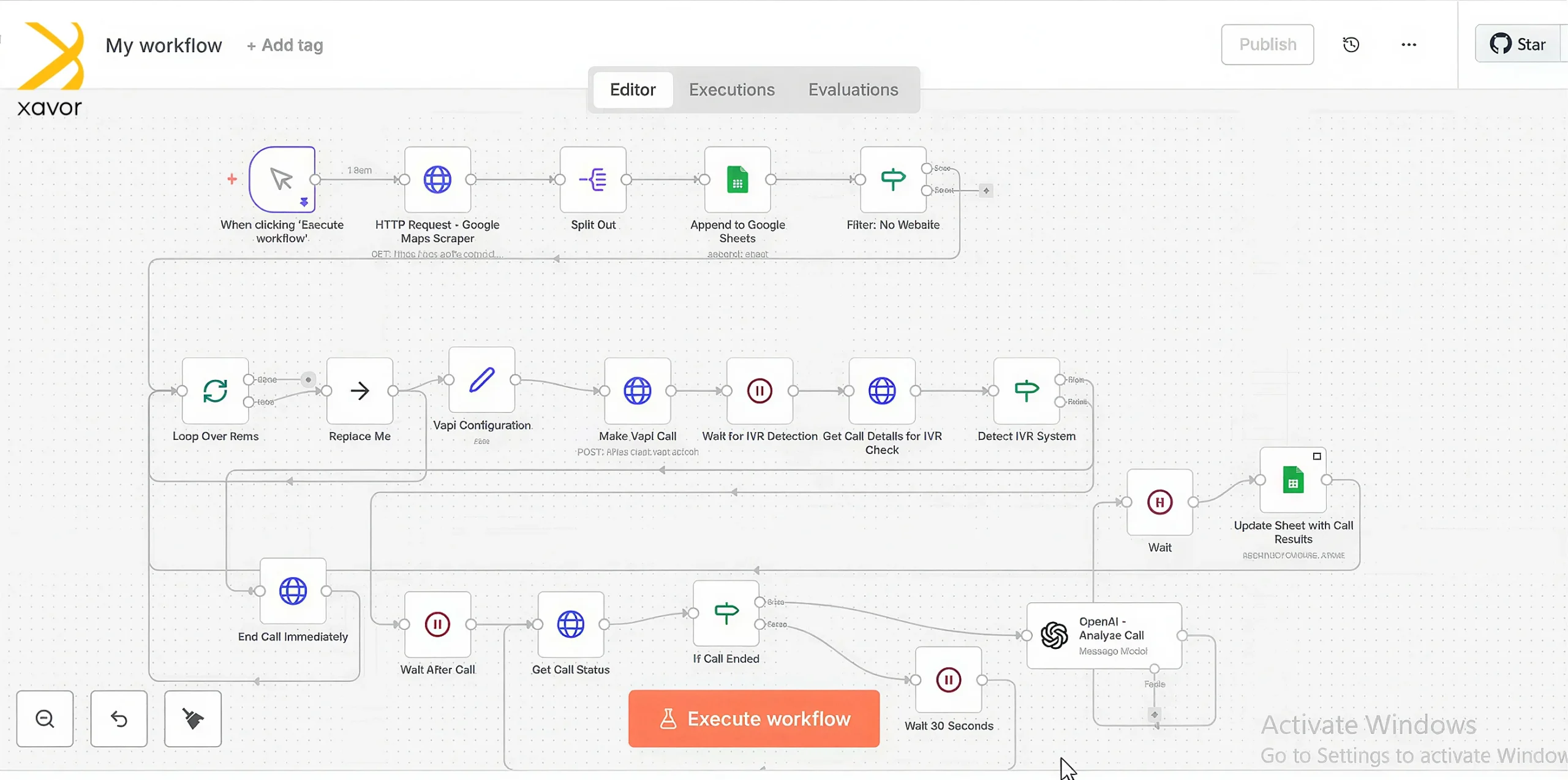
The first prize winner of this bootcamp identified a massive gap: many local businesses don’t even have a basic website. The goal was to reach out to service providers without a digital presence to offer them web solutions. The challenge, however, was finding out who has a website at scale.
The solution was an automated workflow using n8n AI agents. First, it uses a Google Maps Scraper to identify all relevant businesses in any location—dentists in Brussels, roofers in Michigan, etc.—and fetches whether they have a website.
Then, it sends the lead data into Google Sheets. The n8n automation sends the lead into a workflow and triggers outreach. The second part of the automation uses AI-powered IVR outreach to contact businesses without a website through telephony. A voice flow calls the business, explains the offer, and captures interest. If they reply, calls are routed to the relevant department.
The panel admired the smart use of AI in this project as an autonomous SDR. The builder specifically used the n8n automation platform to tackle challenges until the code was perfect. This is exactly the kind of mindset we want builders to come out with.
2. StoryForge: An adaptive writing studio
Writers have mixed feelings about AI. ChatGPT has made work a bit easier, but it has also ruined perfectly good sentence structures. Writers recognize the generic cadence of AI—the repetitive “it’s not just X, it’s Y” structures that audiences immediately flag as artificially generated.
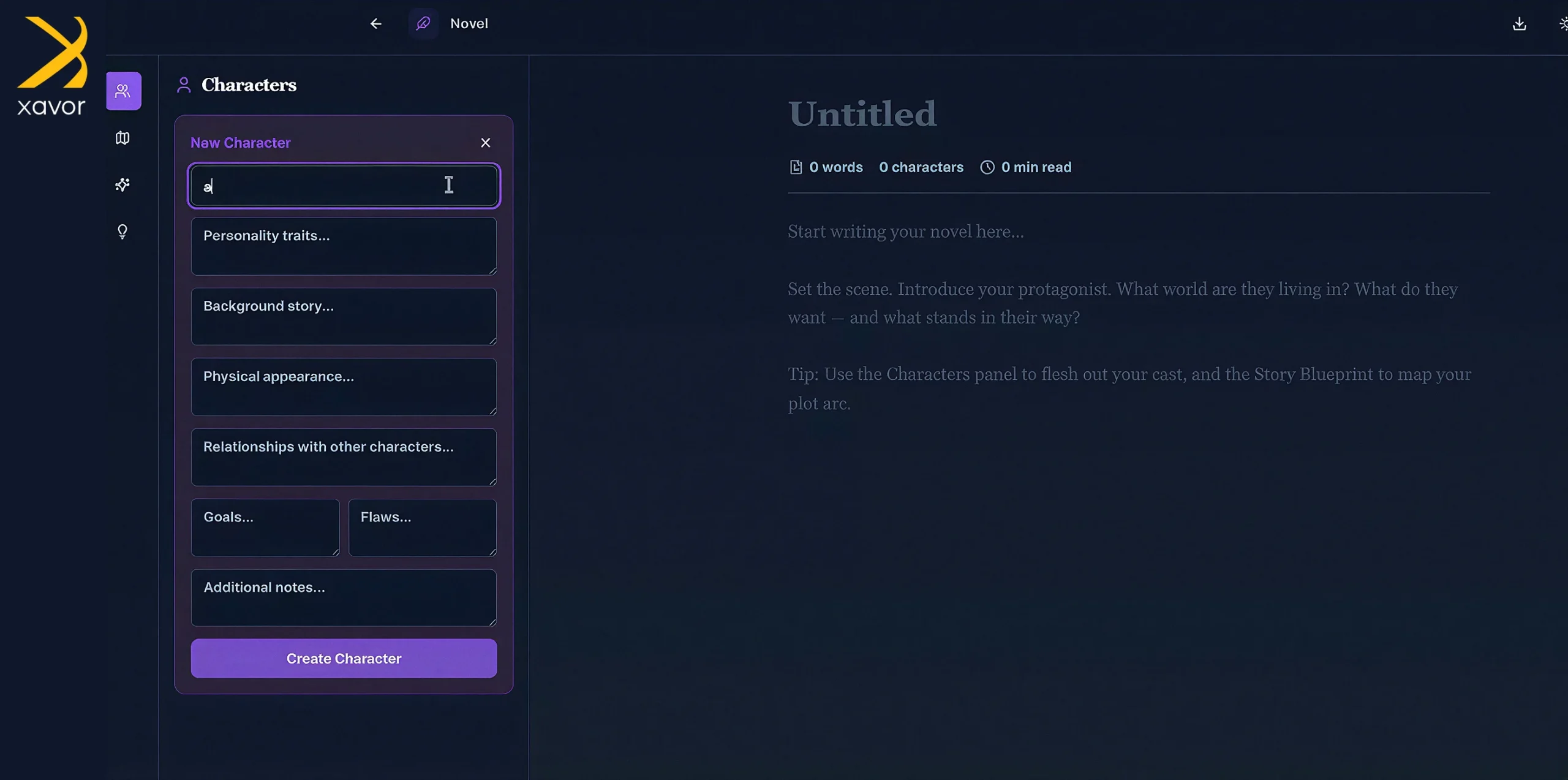
To solve this, one builder developed StoryForge, a Conversational AI writing assistant that doesn’t just churn out insipid words. Rather, it helps you write pieces for any genre or style exactly how you want them.
For fiction writing, if a story is in you, just tell StoryForge what you want and get out of the way. It will draft a complete story blueprint with character traits, goals, and relationships. You can also tell the writing assistant if there is a particular style you want to follow. Want to write a novel in the minimalist style of Hemingway? Or a Kafkaesque psychological work with surreal events? If you like short stories, the tool can mimic the dramatic stories of Chekhov with subtle realism mixed with humor.
It doesn’t stop there, as StoryForge includes non-fiction functionality as well, providing research-oriented tools for writing technical documents, reports, or corporate communications.
This project was contrarian in a way: using AI to de-AI writing, and it worked really well. The jury loved the fiction blueprint feature because it augments the writer while respecting their agency and craft. This solution is perfectly aligned with where the content market is heading.
3. NexusAI: Autonomous Corporate OS
The builder behind NexusAI tackled a notorious enterprise bottleneck, taking on a new stack involving Supabase and Tailwind CSS to solve a very real operational drag for HR teams.
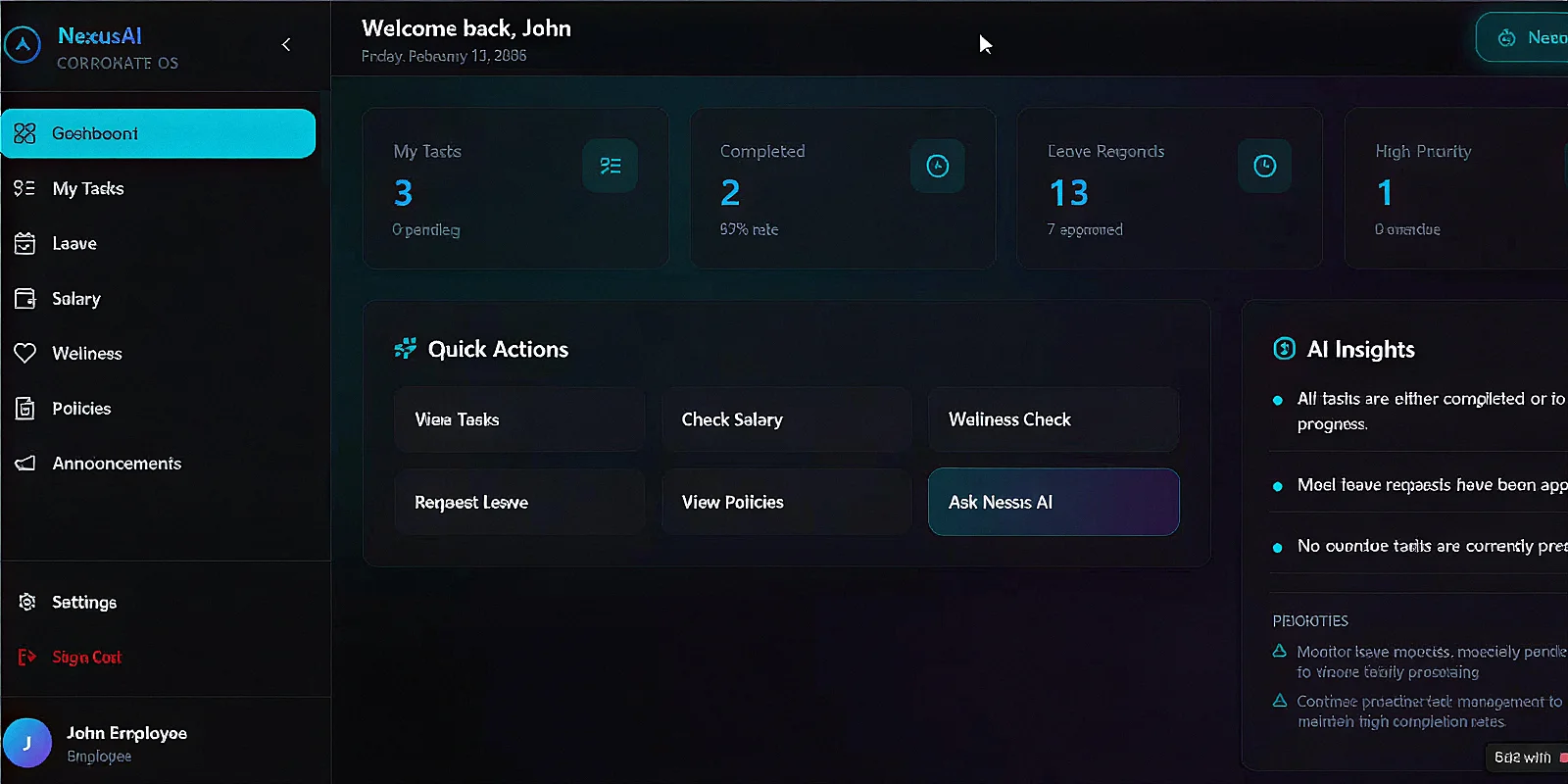
Corporate systems today are overloaded with information but underpowered in execution. It’s not an exaggeration to say that HR teams are often forced into treating employees like they need constant administrative hand-holding. They have to resolve every little problem, answer the same questions on a loop, chase approvals, and still somehow be expected to “drive culture” on top of it all.
To solve this, NexusAI recreates the Employee Management System (EMS) as an Autonomous Corporate OS. This project is a perfect solution for HR admins, employees, and managers alike. Nexus’s core innovation uses AI agents with system-level permissions that can:
- Approve leave
- Create announcements
- Navigate UI pages via natural language processing
- Detect scheduling conflicts before recommending approvals
By stepping into unfamiliar territory and choosing a problem often ignored as “just internal ops,” this builder didn’t complain about the system; they rebuilt it. Utilizing tools like ChatGPT and GitHub to debug under pressure, they demonstrated the judgment to use AI where it actually removes work instead of adding complexity. That is why they shipped both a project and a tangible business outcome.
Where VCB fits in the AI transition
Everyone wants to shift to AI. But not everyone is approaching it the right way. Xavor VCB is our experiment to prove that the AI transition requires the ability to take a risk first and foremost. Skills can be learned, and with vibe coding, learning new skills is easier than ever.
However, the guts to step into the unknown cannot be learned. You can’t lecture people into developing fortitude. That’s what Xavor VCB is designed to do. Participants repeatedly hit the moment of “I’m stuck.” Then, they had to take the next step themselves. Maybe ask a better question, try a different approach, or break the problem down. The idea is to test something imperfect, learn from the failure, and move forward.
Over time, that builds a very specific ability: decision-making under uncertainty.
In normal environments, that ability gets weak because everything is designed around certainty. But in the AI era, progress comes from moving even when the path isn’t clear. The bootcamp forced people to practice that until it became natural.
What companies get wrong about AI upskilling
AI upskilling is becoming the new corporate must-do. Every company can feel it, but AI isn’t just another software rollout. It’s a shift in how work itself gets done.
Here’s what keeps happening: A company decides it needs to train everyone on AI. They roll out prompt-engineering modules, a few tool walkthroughs, and maybe a certification at the end. People complete the videos, check the boxes, and go back to work.
And then leadership wonders why nothing really changed. The problem is that a lot of organizations are training for tool use, not work transformation. They teach people how to ask a chatbot for better answers, but they don’t teach them how to rethink the process that produced the question in the first place. So, employees learn to tweak around the edges instead of using AI to redesign workflows.
Then there’s the biggest issue nobody likes to admit: companies often treat AI training like a one-off event. But AI moves too quickly for that. A single workshop can’t keep people current, and it definitely can’t build real fluency. Without ongoing practice, training becomes a temporary burst of enthusiasm followed by drift.
That’s exactly the gap Xavor VCB aimed to close. The bootcamp treats AI upskilling like a journey, not a seminar. VCB trains for what survives. Instead of teaching people what buttons to click, it forces the mindset companies actually need: problem framing, decision-making under uncertainty, and bias for action.
Participants aren’t spoon-fed workflows or given step-by-step instructions. They’re given a real constraint, pressure, and real responsibility. This brings practice back into the equation. Hands-on projects and weekly challenges make learning continuous, updated quickly, and tied to the actual work people do.
In the end, the companies winning at AI upskilling aren’t the ones with the fanciest courses. They’re the ones building a culture where people have time to learn, space to try, and permission to rethink how work should happen.
What is ahead for Xavor VCB
We plan to make Xavor VCB bigger and better with every iteration. The next edition is in the pipeline, and it will double down on our philosophy with tighter constraints and higher standards.
We’re pushing harder on problem selection because the biggest separator between decent projects and standout projects is judgment. Participants who spent time choosing the right problem ended up building solutions that felt inevitable. So, future cohorts will spend more time upfront doing uncomfortable work and validating whether a problem is worth a week of obsession.
Implementation will still be self-driven, but the questions will get sharper. We’ll also raise the bar on AI-native. The goal is to produce builders who can use AI to simplify workflows, not decorate them.
Ultimately, we’re taking VCB beyond a learning program into a talent engine for Xavor Venture Studio—a place where people without perfect résumés can prove themselves through shipped work. What stayed with us from this January 2026 edition wasn’t a single breakthrough moment, but the accumulation of small, bold decisions. It is a space designed for the next person who looks at a complex problem and thinks: Yes, I can build this.
If you’re curious about Xavor Venture Studio, our approach to innovation, or want to talk about how we’re thinking about AI and talent development, reach out at [email protected].
The Xavor Vibe Coding Bootcamp runs quarterly. Applications for future cohorts open on a rolling basis. Building the builders: Inside Xavor’s AI-native talent engine

FAQs
No. The Vibe Coding Bootcamp is open to beginners and non-technical participants as well as experienced professionals. Past cohorts included people who had never written a line of code.
Each cohort runs for four weeks. Participants are challenged to build one working AI product per week, culminating in a Demo Day where projects are evaluated by technical and business leaders.
You can reach out directly at [email protected] to learn more about Xavor Venture Studio, its approach to AI innovation, and upcoming Vibe Coding programs.