
Case Study
Standardizing Cross-Team Collaboration with Salesforce and Slack Integration for Enterprise Services
Solution
CRM Collaboration | Workflow Automation
Industry
Enterprise Services | Consulting Operations
Core Technology
Salesforce | Slack Enterprise Grid | Einstein GPT | Workflow Builder
Overview
A basic process as team collaboration often becomes a complex procedure in large organizations. Our client, a global professional services firm, faced this exact challenge. Salesforce was their main system of record for customer and business data. But their day-to-day communication occurred across a myriad of emails, meetings, and disconnected communication tools.
So, this created information silos that required employees to sleuth through piles of information to coordinate approvals and transfer context between teams.
Xavor was called in to create a more connected and efficient operating model using Salesforce solutions and Slack for company data to exist in a single environment.
Business Challenge
Before integration, the firm’s sales and support teams suffered from fragmented workflows. Critical updates were buried in email threads or siloed in Salesforce, which caused delays and miscommunication.
And this was a problem, because a stalled deal usually required pinging multiple people for approvals, while a complex service case hopped between three or more agents in email or meetings. This traditional tiered support model created challenges:
1. Slow Approval Processes
A single deal often required approvals from multiple stakeholders across different teams. Since communication happened through emails and separate systems, approvals were delayed, and deals took longer to move forward.
2. Constant Context Switching
Employees had to repeatedly switch between Slack and Salesforce to find information, update records, and communicate with colleagues. Constant switching reduced productivity and made it harder to stay aligned with customer status.
3. Inefficient Customer Support Workflows
Complex customer service cases are frequently passed between multiple agents and teams. Each handoff increased resolution time and created the risk of losing important context about the customer issue.
4. Limited Cross-Functional Visibility
Teams outside of Salesforce, such as Finance or Product Management, often had little visibility into customer opportunities unless they were manually included in discussions.
5. Operational Bottlenecks and Higher Costs
The lack of a shared, real-time collaboration environment led to communication bottlenecks, slower decision-making, longer case resolution times, higher support costs, and lower employee engagement.
the solution
Xavor implemented a Salesforce-Slack integration strategy that transformed Slack into a centralized collaboration hub directly connected to the organization’s CRM data. Rather than forcing employees to switch constantly between applications, the solution embedded Salesforce records and workflows directly within Slack conversations.
Salesforce-Slack Integration:
The integration was accomplished by installing Salesforce’s official Slack app and using Salesforce Channels, which are specialized Slack channels that bind to Salesforce records such as Accounts, Opportunities, and Cases. Each channel displayed a sidebar with the live record’s details and related lists right in Slack.
Workflow Automation:
Workflows and bots further automated the process. Using Slack’s Workflow Builder, the team created approval flows: e.g., a rep types /approve-deal or clicks an “Approve” button in the channel, and the workflow transitions to the deal stage and notifies stakeholders.
AI-Powered Summaries:
Over time, Einstein GPT (Slack’s AI) was enabled to summarize channel activity on-demand, so managers could get up to speed on a deal’s status with a slash-command summary instead of reading every message.
Context-Rich Collaboration:
Teams then communicated in those channels. For example, a #deal-approvals-<ID> channel might include the sales rep, deal desk, legal, and finance. Within Slack, they see account context and can click buttons to update opportunities or submit approvals, all without leaving the chat.
Collaborative Case Resolution:
Service teams set up “case-triage” channels where support agents and product specialists swarm on complex cases together (inspired by Salesforce’s own case-swarming model. Notifications of new cases or escalations were routed automatically to the right Slack channels.
Building this digital HQ, as we like to call it, allowed the company to break down silos. Salesforce data and Slack conversations were literally one and the same workspace. Teams that previously operated in isolation now see a shared view of each customer.
For example, as one executive put it, “Salesforce channels have fundamentally changed the way our teams operate. Being able to access Salesforce data directly in Slack – and combine it with rich conversation – has dramatically improved speed and clarity.”
outcomes & benefits
After 12–18 months, the company saw significant improvements. The table below summarizes key metrics before and after the initiative (with assumptions noted):
- Increased Slack Adoption Active Slack usage increased from approximately 10% to 75–80% of target teams.
- Reduced Email Burden Internal collaboration emails dropped from 1,000 to 600 messages per week, representing a 40% reduction in email traffic.
- Improved CRM engagement 2,000+ Salesforce records are updated per month through Slack, up from virtually zero before the integration, driving greater CRM engagement and workflow efficiency.
- Fewer Cross-Team Handoffs 50% fewer cross-team handoffs, reducing the average number of handoffs per deal or service case from 3.0 to 1.5 and improving collaboration speed.
- Shorter Approval Cycle 50% reduction in deal approval times, which decreased the average approval cycle from 48 hours to just 24 hours.
Importantly, we have documented these outcomes with hard data (emails and case metrics) wherever possible; where exact numbers aren’t available, we clearly note assumptions (e.g., average records per month updated via Slack).
Tools & tech stack
The Salesforce App for Slack
Slack Workflow Builder
Native Slack actions (the Salesforce-in-Slack “quick actions”)
Einstein GPT for Slack summaries
QL (Quip) for document collaboration where needed.
Implementation Plan and Timeline
The implementation unfolded in phases over 12–18 months, as shown below:

In Months 1–3, Salesforce and Slack were integrated, and a pilot was launched. By Months 4–6, dedicated Slack channels were created for top-priority use cases.
Months 6–12 saw expansion: case-swarming channels for support pods were launched, integration of Salesforce approvals into Slack began, and full training rolled out. By Month 9, adoption metrics were already tracked. In Months 10–12, advanced features were added, such as Einstein GPT to produce quick recaps of channel conversations and Tableau Next in Slack.
Throughout the rollout, governance, security, and change-management practices ensured successful enterprise-wide adoption, with the solution fully live by Month 12.
Implementation Architecture (ER Diagram)
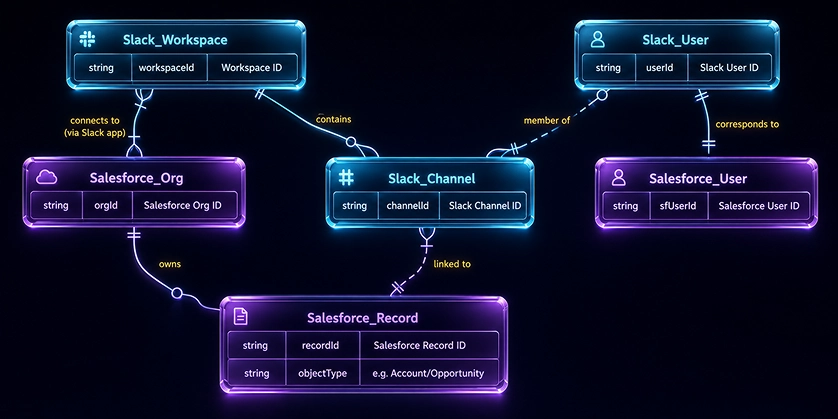
Entity-relationship view of the Slack–Salesforce integration: A Slack Workspace connected to one or more Salesforce Orgs. Within Slack, multiple Channels can be linked to Salesforce Records (Accounts, Cases, etc.). Each Slack user is mapped to a corresponding Salesforce User. Channel membership and record access are enforced by Salesforce’s permission model.
conclusion
This initiative demonstrates how modern collaboration platforms can drive meaningful business transformation when combined with enterprise systems. The integration of Salesforce and Slack replaced fragmented communication and disconnected workflows with a collaborative, data-driven operating model.
If disconnected systems are slowing down collaboration, Xavor can help you integrate Salesforce, Slack, and enterprise workflows into a unified digital workspace
Connect Your Data and Teams now
Xavor helps organizations build integrated digital workspaces that improve productivity.